





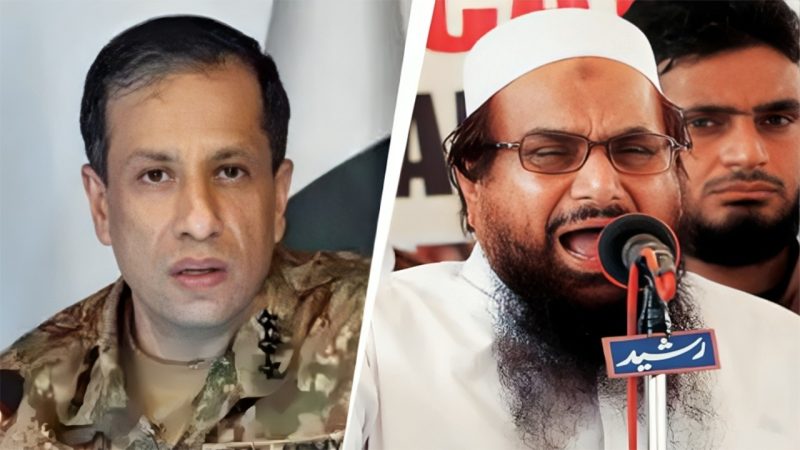
In a shocking development, a Pakistani Army official, Lieutenant General Ahmed Sharif Chaudhry, issued a threat to India using language eerily similar to that of designated terrorist Hafiz Saeed, the founder of Lashkar-e-Taiba. This alarming instance highlights the convergence between Pakistan’s military and its terror networks, raising serious concerns globally.
During an event at a university in Pakistan, Chaudhry declared, “If you block our water, we will choke you.” This statement appeared to reference India’s recent decision to suspend the Indus Waters Treaty, a water-sharing agreement, after the Pahalgam terrorist attack that occurred on April 22, 2025.
A spokesperson for the Pakistani military issued a warning to India regarding the suspension of the Indus Water Treaty,
quoting terrorist Hafiz Saeed with the statement: ‘If you cut off our water, we will cut off your breath.’
pic.twitter.com/hl45IPfLVM— Harsh Patel (@Harshpatel1408) May 23, 2025
This rhetoric bears a striking resemblance to Hafiz Saeed’s infamous statement: “If you stop the water, God willing, we will stop your breath, and then blood shall follow in these rivers.” Videos of Saeed’s earlier speeches, widely circulated online, have drawn direct parallels between the two comments, sparking outrage among Indian and international audiences.
He seems to have copied Lashkr e Taiba’s founder Hafiz Saeed word for word “If India stops the water we will stop their breath” I guess the Pakistani military establishment shares a script with recognized terrorists. 🤷🏻♀️ pic.twitter.com/b6dG4vi4V1
— Mariam Solaimankhil (@Mariamistan) May 22, 2025
Controversy Escalates Online
Lieutenant General Chaudhry’s comments ignited a heated online debate, with critics accusing Pakistan’s military of echoing the terrorist playbook. Afghan politician Mariam Solaimankhil, a former Member of Parliament, joined the discussion with a scathing remark:
“He seems to have copied Lashkar-e-Taiba’s founder Hafiz Saeed word for word: ‘If India stops the water, we will stop their breath.’ I guess the Pakistani military establishment shares a script with recognized terrorists.”
India’s Response: Questioning the Indus Waters Treaty
India has recently raised concerns over the 1960 Indus Waters Treaty following the tragic Pahalgam terrorist attacks. New Delhi’s move to suspend the treaty is part of a broader strategy aimed at holding Islamabad accountable for its continued support of cross-border terrorism.
The suspension of the treaty reflects India’s frustration with Pakistan’s failure to curb terrorist activities originating from its soil. By questioning the treaty, India has signaled its intent to take stronger punitive measures against Islamabad.
Global Implications
The chilling resemblance between the rhetoric of the Pakistani military and Hafiz Saeed underscores the blurred lines between Pakistan’s state apparatus and terrorist organizations. This incident has further isolated Pakistan on the global stage, as the international community continues to demand accountability for its alleged sponsorship of terrorism.
India, meanwhile, remains resolute in its efforts to counter such threats and ensure the safety and security of its citizens.